

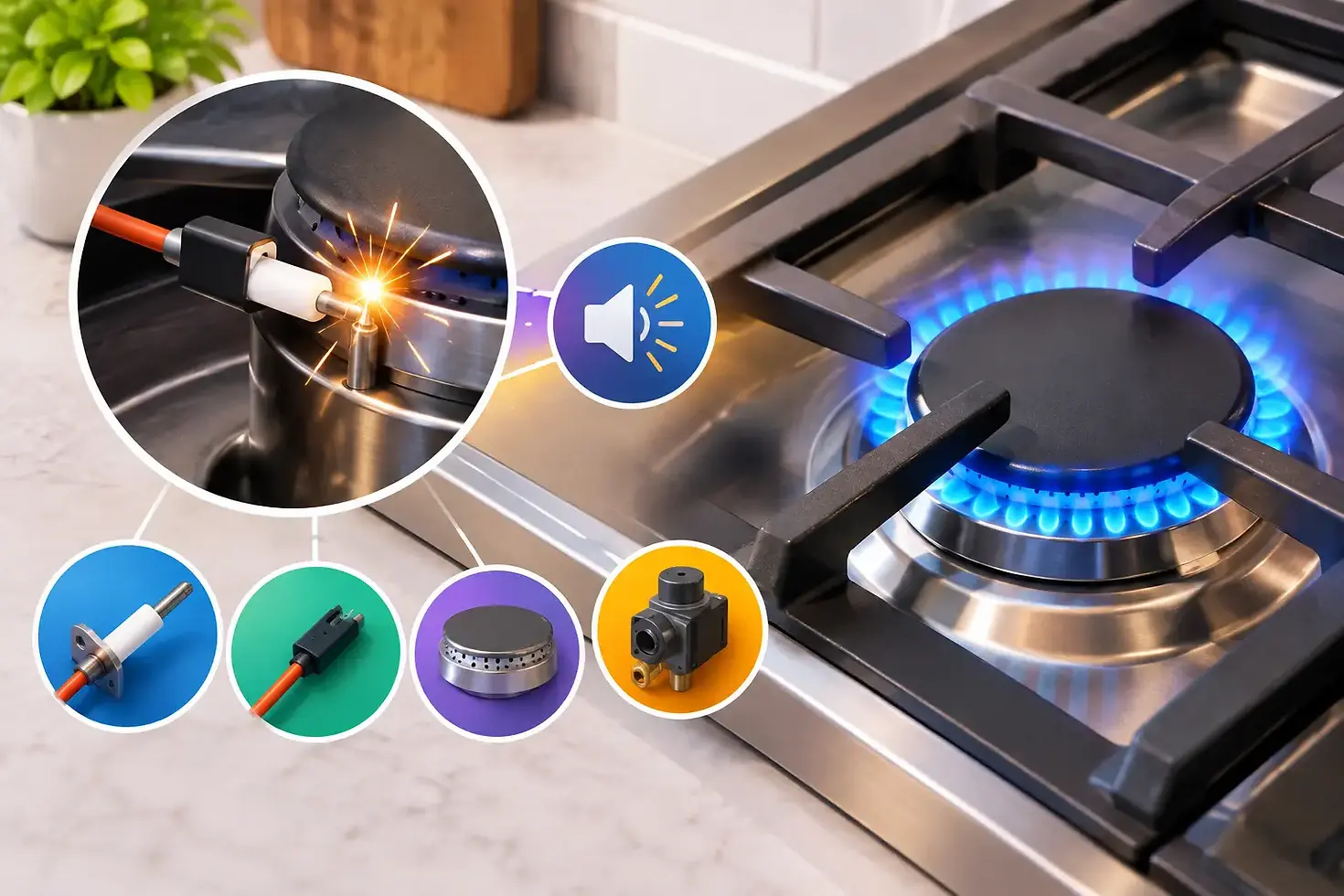
What Causes Gas Igniter Clicking in Appliances?

A gas appliance that clicks continuously after the burner is lit creates more than a customer-service issue. For appliance OEMs and commercial equipment manufacturers, it can signal a weakness in component selection, grounding, enclosure design, or ignition-control integration. Understanding what causes gas igniter clicking helps engineering teams distinguish normal ignition behavior from faults that can affect reliability, safety perception, and product quality.
A clicking sound is produced when an ignition module generates repeated high-voltage pulses. Those pulses travel through an ignition lead to an electrode, where a spark jumps to a properly grounded burner. The system should stop pulsing once the control is released, the ignition switch opens, or the appliance confirms flame, depending on the ignition architecture. Persistent clicking means one part of that sequence is still requesting, creating, or sustaining spark pulses.
What Causes Gas Igniter Clicking After Ignition?
The most common cause is moisture around the burner, electrode, or switch assembly. Water from cleaning, boil-overs, steam, or high-humidity conditions can create an unintended conductive path. In many cooktop systems, that path can make the spark switch behave as though a burner knob is still in the ignition position. The module continues to pulse even when the burner is already lit.
Moisture-related clicking may disappear as the appliance dries, but that does not make it a minor design consideration. Repeated exposure can accelerate corrosion, contaminate insulating surfaces, and reduce the long-term dielectric performance of ignition components. Equipment intended for commercial kitchens or demanding cleaning environments requires particular attention to sealing strategy, component placement, drainage, and material selection.
Food residue, grease, and carbon deposits can create a similar problem. A contaminated electrode may spark inconsistently, direct the spark away from the intended ignition point, or allow current leakage along the ceramic insulator. Grease accumulation around a burner can also interfere with the ground path required for a strong, repeatable spark.
The visible condition of an electrode matters, but the burner assembly matters just as much. A loose burner cap, oxidation on the burner surface, or poor metal-to-metal contact can weaken grounding. The ignition module may still click normally, yet the spark energy will not reach the gas-air mixture where it is needed. This often presents as delayed ignition, intermittent ignition, or clicking that continues while the user waits for flame establishment.
Switch and Control Circuit Faults
In conventional multi-burner gas cooktops, each valve commonly uses a rotary spark switch. Turning any knob to the light position closes the related switch and activates the shared spark module. If one switch remains closed because of moisture, wear, damaged insulation, or internal contamination, every electrode may click even though no knob appears to be requesting ignition.
A stuck or shorted switch is especially relevant in high-use appliances. Mechanical cycling, heat exposure, cleaning chemicals, and routing stress on wiring harnesses all affect switch life. The fault may be intermittent at first, appearing only after a spill or after the appliance has reached operating temperature. For manufacturing teams, intermittent failures are costly because they can pass end-of-line testing yet emerge later in the field.
The ignition module itself can also be responsible. Internal component degradation, damaged high-voltage outputs, compromised input circuitry, or insufficient isolation may cause uncontrolled pulsing. However, replacing the module without testing the electrode, wiring, switches, and grounding can mask the underlying cause rather than resolve it.
Modern appliances add another layer of complexity. Some systems use flame sensing or automatic re-ignition logic. These designs may intentionally continue sparking when a flame is not detected or is lost. In that case, persistent clicking may result from a flame-sensing issue rather than a basic spark-switch fault. Poor burner grounding, a dirty sensing electrode, incorrect polarity where applicable, or a marginal flame signal can prevent the controller from recognizing a stable flame.
Electrode, Lead, and Grounding Problems
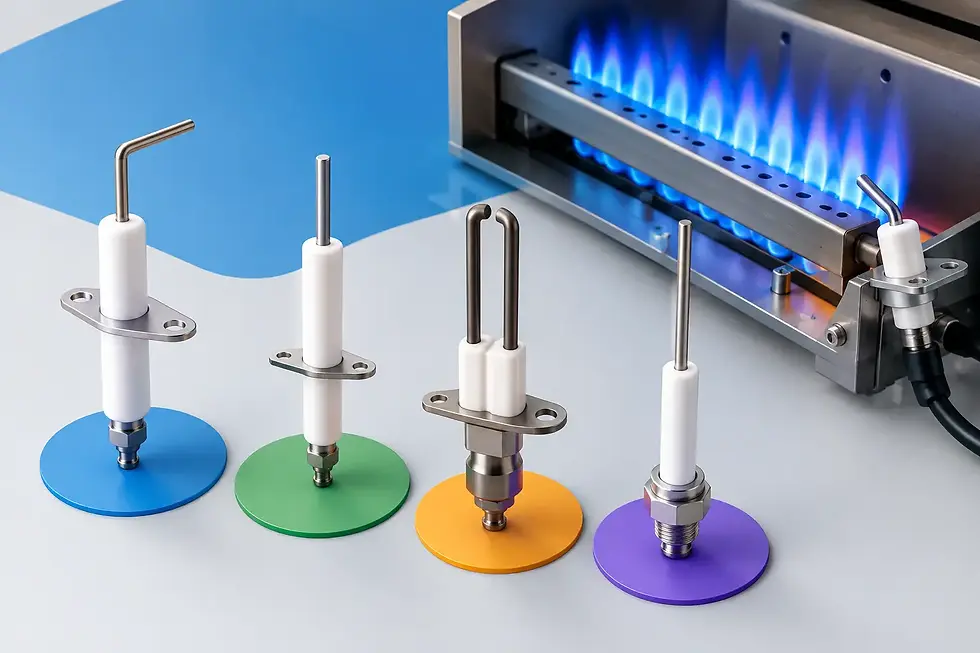
The ignition electrode operates in a high-voltage environment, making its geometry and insulation critical. A cracked ceramic body can allow spark energy to leak to the burner base or chassis instead of jumping across the designed gap. An electrode that has shifted out of position may produce a spark that is too distant from the gas ports, resulting in delayed or unreliable ignition.
High-voltage leads deserve equal attention. Pinched insulation, abrasion against sheet metal, loose terminals, poor routing near heat sources, and inadequate clearance from grounded surfaces can all create leakage paths. The result may be audible clicking without a visible spark at the burner, or a spark occurring at an unintended point inside the appliance.
Grounding is often underestimated because it is not a separate visible component. Yet the spark circuit depends on a dependable return path through the burner and appliance chassis. Painted surfaces, oxidation, loose mounting hardware, contaminated contact points, and poorly designed mechanical interfaces can increase resistance. A weak ground can produce inconsistent spark behavior even when the module and electrode test within specification.
For OEM applications, the electrical and mechanical design must be treated as one system. Electrode placement, burner metallurgy, chassis bonding, harness retention, and assembly tolerances all influence ignition performance. A well-specified module cannot compensate indefinitely for a poorly controlled ground path or inconsistent burner geometry.
Why Continuous Clicking Is Not Always the Same Fault
The sound alone does not identify the failed component. Clicking with no gas flow points toward a switch, control, or module activation issue. Clicking only after washing or a boil-over suggests moisture or contamination. Clicking accompanied by delayed lighting may indicate electrode alignment, burner grounding, or a degraded spark path. Clicking that returns after a burner has been lit can point to flame-sensing or re-ignition logic.
This distinction matters when building diagnostic procedures. A service team that begins by replacing the ignition module may resolve some cases, but it can increase cost and fail to address the environmental or mechanical condition that caused the issue. A structured evaluation should verify the complaint, isolate the affected burner or circuit, inspect for contamination and physical damage, and test switch continuity, electrode integrity, wiring insulation, and grounding.
For products with automatic re-ignition, diagnostics should also verify flame detection under realistic operating conditions. A burner may light successfully in a controlled test but generate an unstable flame signal when exposed to airflow, burner-cap variation, supply-pressure changes, or residue buildup. Product validation should account for those field conditions rather than relying only on initial spark performance.
Design Practices That Reduce Ignition Complaints
Reliable ignition begins with a system-level specification. The spark module must provide appropriate output energy and channel configuration for the appliance, while electrodes must maintain a controlled spark gap and resist thermal cycling. Harnesses need adequate insulation ratings, secure routing, strain relief, and clearance from sharp edges and hot surfaces.
Environmental protection should match the appliance's use case. A residential cooktop, a commercial range, and a specialty gas appliance may face very different spill, steam, grease, and cleaning exposures. Sealed or protected switch arrangements, thoughtfully located drain paths, and contamination-resistant electrode configurations can reduce avoidable service events. The trade-off is that higher protection can increase component and assembly complexity, so the design should reflect the actual duty cycle and service environment.
Manufacturing controls are equally significant. Small variation in electrode position, burner seating, grounding hardware torque, or harness connection quality can create a large difference in field performance. End-of-line spark verification is useful, but stronger programs also include mechanical fit checks, high-voltage leakage testing where appropriate, and validation after thermal, moisture, and contamination exposure.
For appliance brands developing a new platform or updating a legacy design, custom ignition engineering can reduce these integration risks. Electronica Eltec develops spark ignition modules, ignition electrodes, and application-specific control solutions with the design-for-manufacture perspective needed for OEM production.
A clicking igniter is ultimately a signal that the ignition system is behaving differently than its intended control sequence. The most effective response is not to treat it as an isolated noise, but to trace the complete path from user input and control logic to high-voltage delivery, spark location, grounding, and flame confirmation. That approach produces appliances that light reliably, service efficiently, and earn trust over years of use.


Comments