

In House vs Outsourced Electronics
- Pablo Beitman
- 3 days ago
- 6 min read

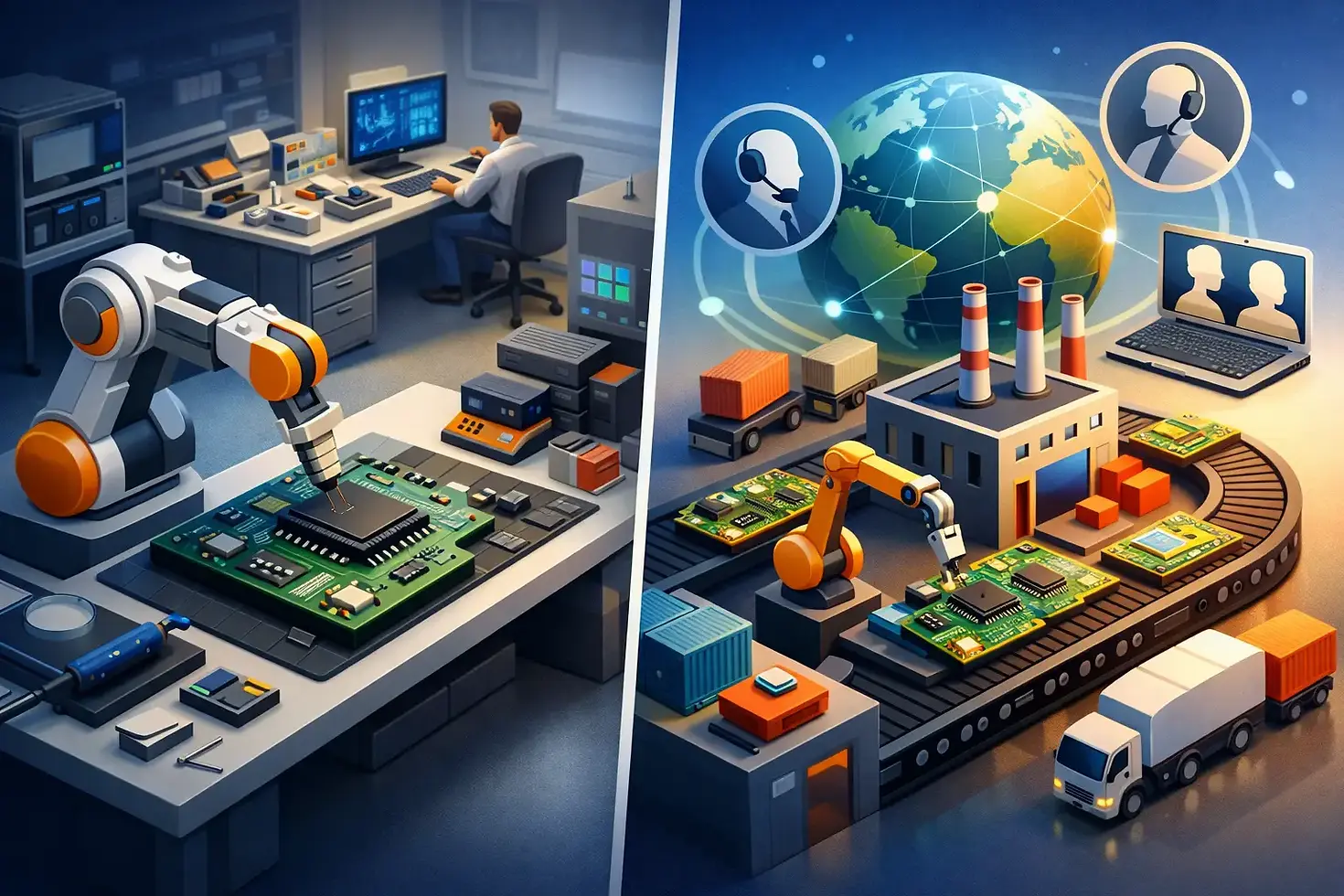
A delayed controller redesign can stall an appliance launch, tie up engineering resources, and create avoidable sourcing risk. That is why the in house vs outsourced electronics decision is rarely just about cost. For OEMs and industrial manufacturers, it affects speed to market, product quality, documentation control, production readiness, and long-term support.
The real question is not which model is universally better. It is which model fits your product, your internal capabilities, and your growth plans. In many industrial programs, the right answer depends on how much specialized design work is required, how tightly hardware and manufacturing need to align, and whether your team is built to support electronics across the full lifecycle.
How to think about in house vs outsourced electronics
When companies compare internal development with external support, they often focus too narrowly on headcount or piece price. That misses the operational reality. Electronics programs succeed when design, validation, sourcing, manufacturing, and after-care work as one system.
An in-house model gives you direct ownership of engineering decisions, design files, testing priorities, and change management. That can be valuable when electronics are core to your competitive advantage or when products require constant iteration across multiple platforms. Internal teams also carry institutional knowledge that can support adjacent product lines over time.
Outsourced electronics, by contrast, can give you access to specialized expertise without the time and fixed cost of building that capability internally. This is especially relevant for custom controllers, connected devices, ignition systems, or application-specific electronics where design for manufacturability and compliance planning must be handled carefully from the start.
The strongest outsourcing relationships do not function as simple vendor transactions. They operate as engineering partnerships, where the external team understands your operating environment, product constraints, production targets, and support expectations.
Where in-house electronics make sense
Building electronics capability internally can be the right strategic move when your product roadmap is large enough to justify permanent engineering investment. If you are releasing frequent hardware updates, managing proprietary control logic, or developing a platform that will feed multiple product families, the business case for an internal team becomes stronger.
In-house teams also make sense when cross-functional coordination is constant. If mechanical engineering, firmware, software, and product management need daily interaction, keeping the group under one organizational structure can simplify communication. For companies with mature quality systems and established procurement functions, internal electronics development may fit well into existing operations.
Control is the main advantage. Your team sets priorities, protects sensitive know-how, and responds immediately to design changes. That said, control is only valuable when the supporting capability actually exists. An understaffed internal team can create more risk than it removes.
Hiring senior electronics engineers, validation specialists, sourcing personnel, and production support staff is expensive. Keeping them aligned with current technologies and compliance requirements takes ongoing investment. The hidden cost of in-house development is not only payroll. It is the infrastructure behind it - test equipment, supplier management, prototype iterations, documentation discipline, and manufacturing transfer readiness.
Where outsourced electronics create an advantage
Outsourcing can reduce complexity quickly, particularly for OEMs that need a custom electronic subsystem but do not want to manage every stage internally. This is often the case in appliance, refrigeration, HVAC, ignition, and industrial control applications, where the electronics must be reliable, application-specific, and production-ready.
A qualified external partner can compress development timelines because the engineering tools, manufacturing processes, and specialized experience are already in place. Instead of building capability from the ground up, you plug into an established system. That can be decisive when launch timing matters or when your internal team is already committed to higher-level product architecture.
Outsourced electronics can also improve manufacturability. Design decisions made in isolation often create avoidable production issues later - component availability problems, assembly challenges, test inefficiencies, or field service complications. A partner that handles both engineering and production can anticipate those issues earlier and design around them.
This is one of the biggest differences in the in house vs outsourced electronics discussion. Outsourcing is not simply external labor. In the right structure, it is access to integrated design and manufacturing thinking that reduces friction across the product lifecycle.
The trade-offs that matter most
Cost is important, but it should be evaluated correctly. In-house teams may appear less expensive per project once they are fully utilized, but that assumes a steady pipeline of work, stable staffing, and efficient execution. If project volume fluctuates or specialized knowledge is only needed intermittently, fixed internal cost becomes harder to justify.
Outsourcing shifts some of that burden into a project-based model. You pay for capability when needed, but you may give up some day-to-day control. That trade-off is reasonable when the partner provides strong technical communication, clear documentation, and disciplined change management.
Speed is another common consideration. Internal teams can move quickly when they already have the right experience and enough bandwidth. If they do not, external specialists are often faster. The timeline benefit comes not from working harder, but from avoiding the delays that come with capability gaps.
Quality depends less on where the work is done and more on how the process is managed. Internal teams can produce excellent results. So can outsourced teams. Problems arise when requirements are unclear, validation is weak, or manufacturing input comes too late. Quality follows engineering discipline, not organizational charts.
Intellectual property is often raised as a reason to keep everything internal. In some cases, that is justified. But many companies overestimate the practical risk and underestimate the operational risk of developing complex electronics without the right expertise. IP protection matters, but so do field reliability, traceability, and supply continuity.
A hybrid model is often the most effective
For many manufacturers, the best answer is not fully internal or fully external. It is a hybrid structure where internal teams retain product ownership while a specialized partner handles selected parts of the lifecycle.
That may mean your team defines requirements, customer use cases, and product strategy while an external engineering and manufacturing partner develops the hardware, prototypes the assemblies, validates the design, and supports production ramp-up. It may also mean keeping firmware architecture internal while outsourcing board design and hardware manufacturing.
This model works well when you want to preserve strategic control without carrying the full burden of electronics development infrastructure. It also helps when a project requires niche expertise - such as IoT connectivity, thermal control electronics, ignition systems, or custom industrial controllers - that your internal group does not need on every program.
A company like Electronica Eltec fits this model well because design, development, and manufacturing are handled within one partner relationship. That reduces the handoff problems that often appear when engineering and production sit with separate suppliers.
Questions to ask before deciding
The right decision usually becomes clearer when you assess operational realities instead of assumptions. Start with product complexity. If your electronics are highly customized, safety-critical, or tightly integrated with the application, you need a model that can support deep technical work and production consistency.
Next, look at internal bandwidth. Even capable teams reach a point where new projects compete with existing support obligations. If ongoing maintenance is consuming your engineering resources, outsourcing new development may protect schedules and reduce overload.
Then evaluate lifecycle needs. Development is only one phase. Ask who will support design revisions, component substitutions, test development, production scaling, and field issues. Many companies underestimate the long tail of electronics support.
Finally, assess partner fit. If you outsource, you need more than technical talent. You need process discipline, application understanding, manufacturing capability, and long-term reliability. The wrong partner creates delay. The right one extends your team and improves execution.
Making the decision with fewer surprises
The in house vs outsourced electronics choice should be based on business fit, not ideology. Internal development offers control and can build lasting capability. Outsourcing offers flexibility, specialized knowledge, and faster access to production-ready execution. Hybrid models often provide the best balance.
What matters most is whether your chosen model can reliably take a product from concept to manufactured hardware without creating gaps between engineering intent and production reality. If your electronics directly affect product performance, service life, and market timing, that alignment is not optional.
A good decision here does more than support one project. It gives your organization a more stable way to develop the next one.

Comments