

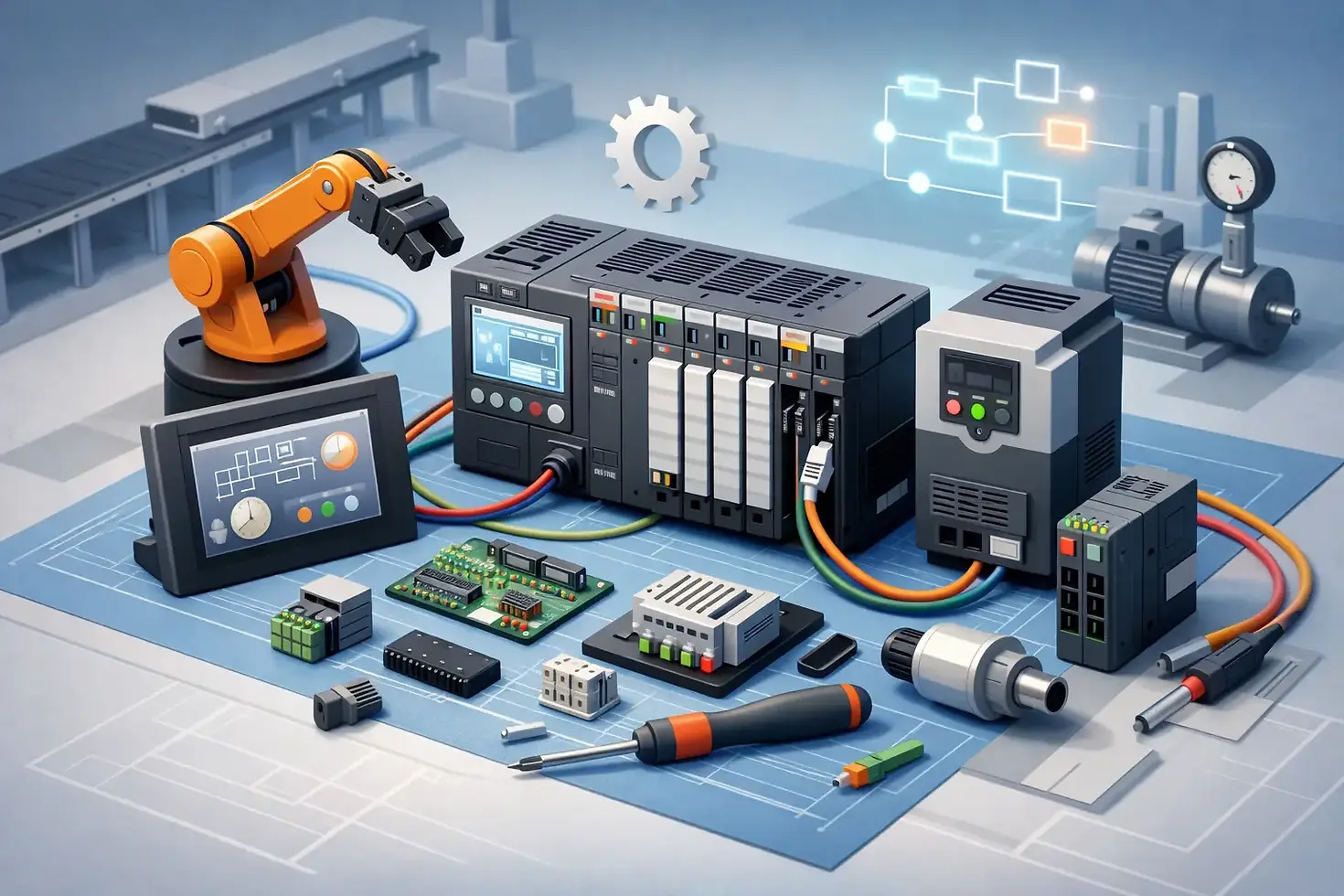
How to Build Industrial Controllers
- Pablo Beitman
- 7 days ago
- 6 min read

A controller that works on the bench can still fail in the field for entirely predictable reasons - electrical noise, heat, relay wear, unstable inputs, poor enclosure design, or firmware that was never written for real operating conditions. That is why learning how to build industrial controllers starts with the application, not the board layout. For OEMs and industrial equipment manufacturers, the real objective is not just control logic. It is a controller that can be manufactured consistently, deployed reliably, and supported over the product lifecycle.
How to build industrial controllers around the application
Industrial controllers are rarely generic products in practice, even when the function appears straightforward. A refrigeration system, gas ignition platform, AC regulator, or connected appliance each has different electrical, environmental, and regulatory demands. The most effective development process begins by defining what the controller must sense, decide, and actuate under real operating conditions.
That means clarifying the input types, output loads, timing requirements, safety logic, communications needs, and service expectations before selecting hardware. An engineering team should also define the installation environment early. Ambient temperature range, humidity, vibration, dust exposure, line voltage variation, and electromagnetic interference all influence architecture choices. If those constraints are treated as late-stage details, redesign becomes expensive.
A common mistake is starting with an available microcontroller or reference design and shaping the product around it. That can work for simple devices, but in industrial applications it often creates avoidable limitations. A better approach is requirements-first engineering, where the platform is selected only after the control strategy and field conditions are understood.
Start with system architecture, not components
A strong industrial controller is built from a clear hardware and firmware architecture. At this stage, the goal is to divide the system into functional blocks: power supply, processing, sensing, output stages, user interface, communications, protection, and diagnostics.
The power stage deserves particular attention. Industrial equipment often faces voltage fluctuation, surges, transients, and grounding issues that do not appear in lab conditions. Power conversion and protection design should account for those realities from the beginning. Isolation may be required between high-voltage and low-voltage domains, especially in appliances, HVAC, ignition systems, and motor-related applications.
Processor selection should follow control complexity, I/O count, memory needs, response time, and communications requirements. More processing power is not always better. In many cases, a simpler architecture improves reliability, shortens validation, and reduces cost. But if the controller will support connected diagnostics, advanced state logic, over-the-air updates, or multiple communication stacks, the firmware and memory budget must be sized appropriately.
Output topology is another area where application specifics matter. Relays are still practical in many designs, but they introduce wear, switching limitations, and acoustic noise. Solid-state outputs improve longevity and speed, though they can increase thermal management demands and cost. The right answer depends on duty cycle, load type, expected lifetime, and service model.
Component selection is an engineering decision, not a purchasing shortcut
When teams discuss how to build industrial controllers, the conversation often moves quickly to bill of materials cost. Cost matters, but selecting components purely for lowest unit price tends to create larger problems later in manufacturing and support.
Key components should be evaluated for lifecycle stability, supply continuity, temperature performance, certification relevance, and second-source options where possible. This is especially important for OEM programs with multi-year production horizons. A controller that depends on unstable component availability can become a commercial risk, not just a technical one.
Sensors, connectors, protection devices, and switching components deserve the same scrutiny as the processor. Field failures often come from the supporting hardware rather than the core logic device. Terminal quality, connector retention, creepage and clearance, and protective circuitry are not secondary details in industrial electronics. They are part of the controller's functional reliability.
This is also where design for manufacturability should begin. Package selection, PCB assembly constraints, test access, and calibration methods all affect production quality. If the design team and manufacturing team are not aligned early, a controller may be technically sound but difficult to build at scale.
Firmware must be written for fault conditions
Industrial firmware should not assume ideal inputs or clean system behavior. It must be designed around abnormal conditions, startup transients, sensor drift, communication interruptions, brownouts, and unexpected operator actions. In practical terms, that means fault handling is not an add-on. It is core functionality.
State-machine architecture is often the safest path for industrial controller logic because it makes transitions, interlocks, and fault responses easier to validate. Watchdog strategies, event logging, input filtering, debounce logic, and safe fallback modes should be built into the firmware plan from the outset.
Diagnostics are equally important. A controller that fails silently creates expensive service calls and difficult root-cause analysis. By contrast, a controller that reports fault states, stores critical events, and supports efficient troubleshooting adds value long after shipment. For OEMs, this can reduce downtime, improve service response, and protect the end product's reputation.
If connectivity is included, it should solve a real operational problem. Wi-Fi, BLE, or other interfaces can support configuration, monitoring, and predictive maintenance, but they also add complexity in cybersecurity, certification, firmware maintenance, and user support. Connected features are worthwhile when they align with the product strategy, not when they are added because the market expects them in theory.
Validation is where controller quality is proven
A controller is not ready because the prototype functions correctly. It is ready when testing shows it can survive the conditions it will actually face. Validation should cover electrical performance, thermal behavior, EMC exposure, power anomalies, long-duration operation, and edge-case logic.
This is one area where trade-offs become very clear. Extensive testing adds time and cost upfront, but insufficient validation shifts those costs into warranty claims, production interruptions, and field failures. For industrial and appliance applications, that is rarely an acceptable trade.
Pre-compliance testing should be considered early, especially for products that will require formal approvals or operate in electrically noisy environments. It is far more efficient to identify susceptibility or emissions issues before the design is frozen. Thermal testing is equally critical. Output stages, power supplies, and enclosed installations can create heat-related failures even when average current appears acceptable on paper.
Life testing also matters. Switching cycles, compressor starts, ignition events, fan control, and repetitive load behavior can expose wear mechanisms that a short engineering test will miss. The controller should be tested as part of the system, not only as an isolated PCB.
How to build industrial controllers for production, not just prototyping
A common gap in controller development appears when a successful prototype moves into volume production. What worked in engineering can become unstable if manufacturing controls, test methods, and documentation are incomplete.
Production-ready controller development requires defined assembly processes, incoming inspection criteria, in-circuit or functional testing strategy, firmware programming controls, traceability, and revision management. The handoff from design to manufacturing should be structured, not informal. This is where vertically integrated partners can create real value by reducing the disconnect between engineering intent and production execution.
Test strategy is especially important. If a controller cannot be tested efficiently at production scale, hidden defects will escape or manufacturing costs will rise. Good design includes test points, repeatable programming methods, and clear pass-fail criteria. Calibration, if needed, should also be practical for production environments rather than dependent on engineering intervention.
Documentation supports all of this. Schematics, BOM control, firmware revisions, work instructions, test procedures, and quality records are part of the product, not administrative overhead. For OEMs, disciplined documentation protects continuity when products are updated, transferred, or serviced over time.
The right development model depends on complexity and risk
There is no single answer to how to build industrial controllers because the right path depends on application risk, expected volumes, compliance needs, and internal engineering capacity. Some manufacturers can manage architecture internally and outsource production. Others need a partner that can handle design, prototyping, validation, and manufacturing under one program structure.
The higher the application complexity, the more valuable integrated development becomes. Safety-sensitive controls, connected devices, refrigeration systems, ignition electronics, and custom appliance platforms usually benefit from close coordination between electrical design, firmware, compliance planning, and manufacturing engineering. Splitting those responsibilities across multiple vendors often slows decisions and increases failure points.
For companies building private-label or OEM equipment, the controller is often one of the most strategic parts of the product. It affects safety, performance, user experience, serviceability, and long-term supply stability. Treating it as a commodity usually creates hidden cost later.
At Electronica Eltec, this is the reason custom controller programs are approached as full lifecycle engineering efforts rather than isolated board builds. The product has to work in the application, on the production line, and in the field over time.
The practical way forward is to build from real operating requirements, engineer for fault conditions, validate under stress, and prepare for production from the start. That is how industrial controllers move from concept to dependable hardware - and why the best results usually come from treating controller development as a strategic engineering decision, not just an electronics task.


Comments