

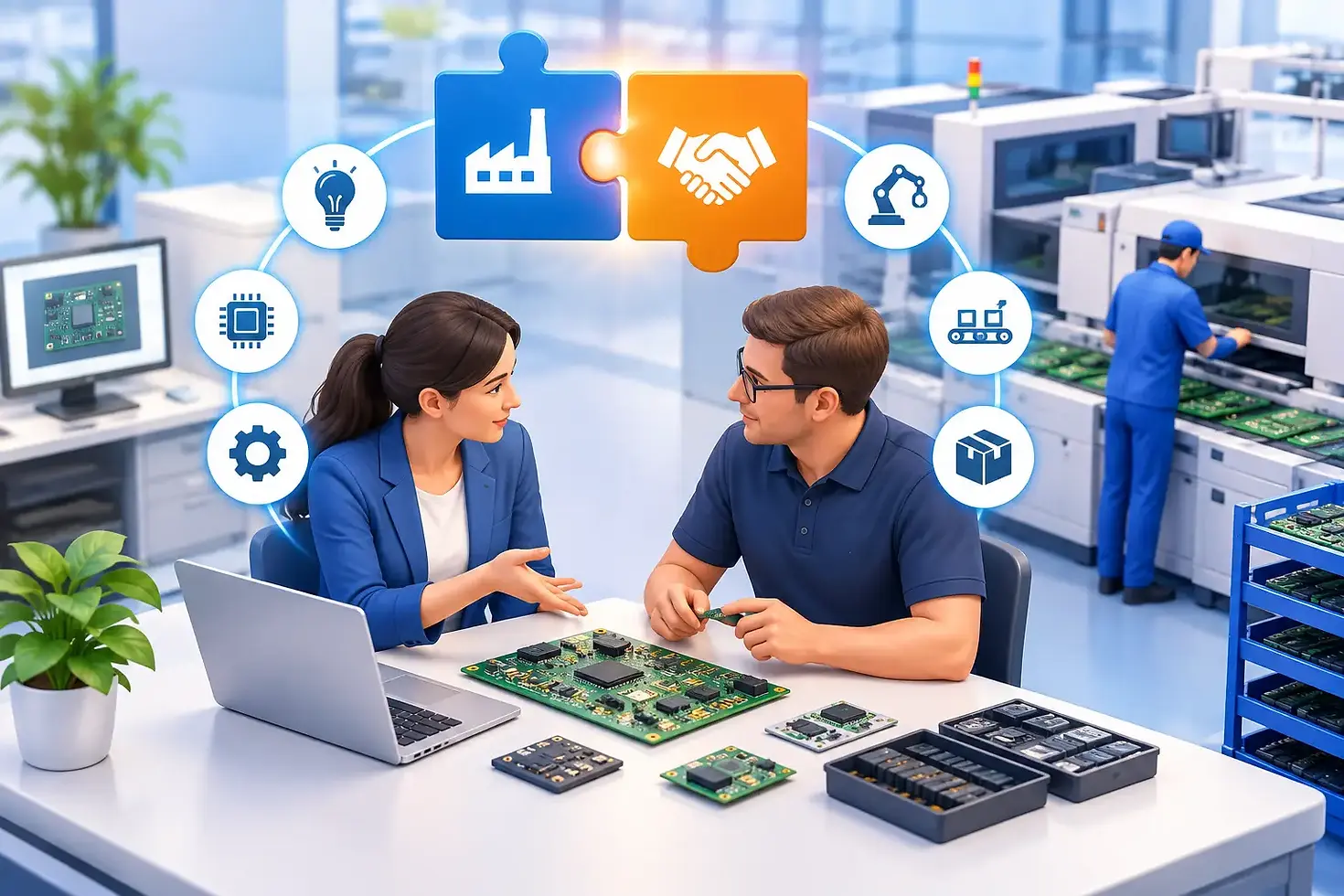
What Does an OEM Electronics Partner Do in Manufacturing?

A gas appliance launch can be delayed by a small electronic subsystem: an ignition module that does not tolerate line variation, an electrode assembly that is difficult to install, or a controller that performs well in the lab but not on a production line. That is where the question, what does an OEM electronics partner do, becomes practical rather than theoretical. The right partner turns a product requirement into an electronic system that can be validated, produced consistently, and supported through its operating life.
For industrial manufacturers and appliance brands, an OEM electronics partner is not simply a contract manufacturer that builds to a supplied file package. A capable partner combines engineering judgment, product development discipline, manufacturing control, and ongoing technical support. The value is especially clear when the product involves safety-sensitive functions, demanding operating conditions, or a need for customization.
What does an OEM electronics partner do?
An OEM electronics partner develops and supplies electronic assemblies that become part of another company’s finished product. Depending on the project, that scope may begin with an early concept or a defined technical need. It can extend through circuit design, embedded controls, prototypes, testing, production, quality control, and after-care.
The job is to reduce the distance between what an OEM needs its equipment to do and what can be reliably manufactured at the required scale. That involves more than selecting components and assembling circuit boards. It requires decisions about electrical performance, mechanical fit, environmental exposure, supply continuity, serviceability, test methods, and production yield.
For example, a manufacturer of gas-powered cooking equipment may need a spark ignition module that delivers dependable ignition under real installation conditions. The partner evaluates the input power characteristics, ignition sequence, high-voltage output, electrode interface, enclosure constraints, cable routing, safety requirements, and expected production volumes. The outcome should be a system designed for the appliance, not a generic module forced into an application it was not built to serve.
Translating requirements into engineering decisions
OEM teams often begin with a commercial or operational objective: improve ignition reliability, add connectivity, replace an aging controller, reduce assembly time, or create a feature that differentiates a product line. Those objectives must be converted into measurable engineering requirements.
An experienced electronics partner works with product, engineering, operations, and procurement stakeholders to define the functional and production constraints. This may include operating voltage ranges, temperature exposure, electrical load behavior, communication protocols, enclosure dimensions, connector placement, regulatory considerations, diagnostic needs, and target cost.
This early work prevents a common development problem: treating the electronic assembly as an isolated part. A controller may meet its basic electrical specification yet create installation errors, complicate field service, or require components with unstable availability. A partner that understands both design and production can identify these issues before they become expensive changes.
Custom design when standard products are not enough
Off-the-shelf electronics can be appropriate for simple, non-differentiating functions. They can shorten the path to market when the application closely matches the standard product’s capabilities. However, standard modules often introduce compromises in form factor, interfaces, control behavior, or long-term availability.
Custom design is justified when performance, integration, safety, or product differentiation matters. In ignition applications, for instance, the relationship between the spark ignition module, ignition electrode, burner configuration, power source, and appliance construction directly affects results. A purpose-built design can account for those variables instead of requiring the appliance to adapt around a generic part.
The trade-off is that custom development requires upfront engineering time and clear decisions. It delivers the strongest return when the OEM expects repeat production, needs control over the design, or cannot accept the limitations of a catalog component.
Developing prototypes and proving the design
A prototype is not merely a first version of a board. It is a decision-making tool. It allows the OEM and electronics partner to verify that requirements are complete, interfaces work as intended, and the design behaves correctly in the intended equipment.
During this stage, engineering teams evaluate performance under relevant conditions rather than ideal ones. For an ignition system, that can mean checking spark consistency, timing, electrical isolation, wiring effects, and behavior across expected supply conditions. For refrigeration controls, it may involve sensor response, compressor switching behavior, temperature stability, and fault handling. For IoT-enabled equipment, it includes Wi-Fi or BLE connectivity, data behavior, and recovery from interruptions.
Testing should also address foreseeable misuse and field conditions. Industrial and appliance electronics must contend with heat, vibration, electrical noise, installation variation, moisture exposure, and component tolerances. The appropriate test plan depends on the application, but the principle remains constant: find failure modes before production scales them.
Designing for manufacturing, not just function
A design that works on a bench is not automatically ready for volume production. Manufacturing readiness is where an OEM electronics partner provides a critical layer of discipline.
Design for manufacturability considers how a product will be assembled, inspected, tested, and handled repeatedly. Component selection must account for availability, approved alternatives, package suitability, and supplier risk. The printed circuit board layout must support reliable assembly and test access. Mechanical choices must allow repeatable fit and protect sensitive elements.
A production-minded partner also establishes clear documentation. Bills of materials, assembly instructions, test specifications, programming procedures, revision controls, and quality checkpoints are not administrative extras. They are the controls that keep the thousandth unit aligned with the approved design.
For OEMs, this integration reduces handoffs. When design and manufacturing are managed by separate organizations, a design change can require lengthy clarification, revisions, and blame-sharing when results fall short. A single partner accountable for both disciplines can resolve issues faster because engineering decisions are informed by production realities from the beginning.
Manufacturing electronic hardware with process control
Once the design is validated, the focus shifts to repeatability. An OEM electronics partner sources components, manages production planning, assembles electronic hardware, conducts inspection and functional testing, and maintains traceability appropriate to the project.
Quality is not created at the final inspection station. It is built through controlled materials, documented processes, trained personnel, in-process checks, and meaningful functional tests. A final test should confirm that each unit performs its intended function, but it cannot fully compensate for weak process control upstream.
Production capacity also needs to match the customer’s operating model. Some OEMs require scheduled recurring supply; others need a ramp from pilot builds to larger volumes. A partner should be able to plan around forecasts, manage reasonable inventory strategies, and communicate constraints before they disrupt the OEM’s assembly schedule.
Cost matters, but lowest unit price is not always lowest total cost. A lower-priced assembly that produces line failures, rework, warranty claims, or inconsistent supply can be substantially more expensive than a well-engineered alternative. Procurement decisions are stronger when they consider lifecycle risk alongside quoted price.
Supporting changes after production begins
Products change after launch. Components reach end of life, supplier conditions shift, regulations evolve, and OEMs introduce new equipment variants. An electronics partner remains valuable when it can manage these changes without compromising performance or production continuity.
That support may include component substitutions, controlled design revisions, failure analysis, field-return evaluation, documentation updates, and engineering for next-generation products. It also includes communication: the OEM should understand what is changing, why it is necessary, what has been validated, and how the change affects inventory or production.
This long-term role is particularly relevant for industrial equipment and appliances with multi-year product lives. A short-term supplier can deliver parts. A strategic electronics partner helps protect the product platform over time.
Choosing the right OEM electronics partner
The best fit depends on the complexity and importance of the electronic subsystem. An OEM sourcing a simple commodity board may prioritize price and availability. An OEM developing a control, ignition, sensing, or connected product should assess engineering depth as carefully as manufacturing capability.
Useful questions include whether the partner can clarify incomplete requirements, build and test prototypes, design for manufacturability, manage component risk, create application-specific test methods, and support product changes after release. It is also worth asking how the partner handles design ownership, technical documentation, quality records, and production issues.
For gas ignition systems, ignition electrodes, and spark ignition modules, application experience matters. High-voltage performance and appliance integration are not areas where generic assumptions produce dependable results. Electronica Eltec applies more than four decades of engineering and manufacturing experience to help OEMs develop electronic systems that fit the actual needs of their equipment.
A productive partnership begins with a clear technical conversation: what must the equipment do, where can it fail, how will it be made, and what will the OEM need from the electronics system five years from now? Answering those questions early creates a better foundation for every unit that follows.


Comments