

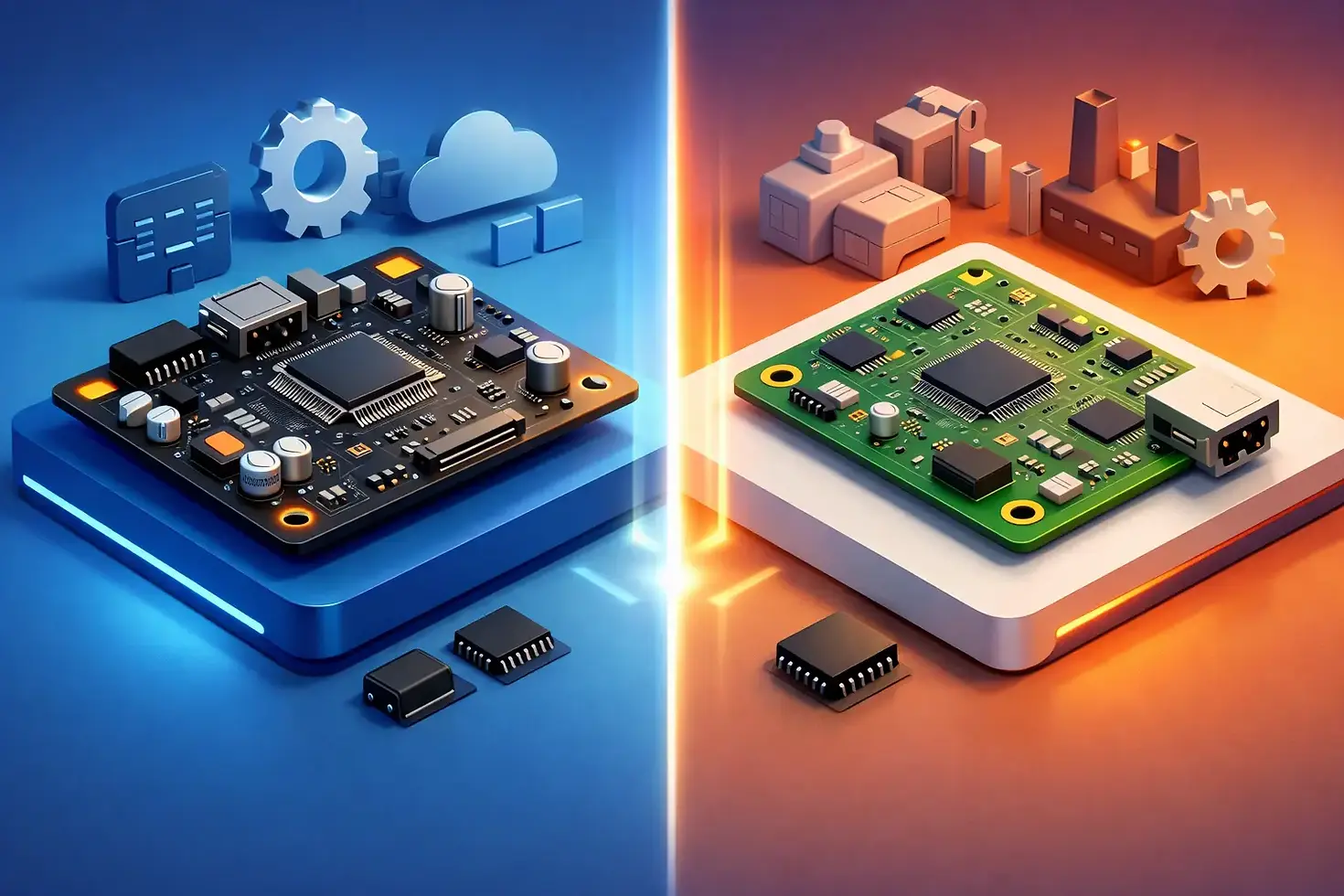
Custom Controllers vs Standard Boards for OEMs

A controller board can look inexpensive on a sourcing spreadsheet and become costly once it reaches the product line. That is the central question behind custom controllers vs standard boards for OEMs: whether a ready-made platform genuinely fits the application, or whether it creates compromises in performance, manufacturing, safety, and support that surface later.
For appliance and industrial equipment manufacturers, the answer is rarely a matter of preference. It depends on the product’s operating conditions, expected production volume, required features, regulatory path, and service life. A standard board may accelerate an early prototype. A custom controller may provide the control, reliability, and supply continuity needed for a long-running OEM program.
The real decision is not custom versus off-the-shelf
Standard boards are pre-engineered electronic platforms designed to serve a broad set of uses. They can include development boards, general-purpose control modules, PLC-style solutions, or commodity boards adapted for a specific product. Their strength is availability: engineering teams can evaluate hardware quickly without funding a complete electronics design from the start.
Custom controllers are designed around the actual product requirements. The input circuitry, power supply, sensing method, outputs, communications, mechanical format, and firmware are specified for one application or product family. This approach requires more engineering effort upfront, but it removes functions the product does not need and builds in the ones it cannot do without.
The practical question is therefore more precise: does the standard board meet the full production requirement without creating material compromises? If the answer is yes, it may be the right choice. If it requires adapters, external modules, unnecessary components, repeated firmware work, or special assembly steps, a custom design often becomes the more disciplined option.
Where standard boards make sense
A standard board is often appropriate during concept validation, low-volume equipment builds, and internal test fixtures. It can shorten the time required to prove a control strategy, evaluate sensors, or demonstrate connected features such as Wi-Fi or BLE. For a product with stable, noncritical requirements and limited production expectations, the lower initial investment can be compelling.
It can also be a sensible option when the controller is not a differentiating part of the final equipment. For example, an auxiliary monitoring function with widely available interfaces may not justify a purpose-built board. In these cases, the engineering team should still confirm the board’s operating temperature range, electrical ratings, supplier support, and projected availability.
The limitation is that a board designed for many applications is rarely optimized for one. OEMs may pay for unused processing power, interfaces, connectors, or communications functions. They may also have to work around physical dimensions that do not suit the enclosure, use an external power supply, or accept a component selection that does not match the intended product lifecycle.
When a custom controller earns its investment
A custom controller becomes particularly valuable when electronics directly affect product performance, safety functions, user experience, or manufacturing efficiency. Gas ignition systems are a clear example. Ignition timing, high-voltage output, flame detection, fault lockout behavior, insulation distances, and environmental resistance must work together as an integrated system. Adding a general-purpose board to separate ignition hardware can introduce unnecessary interfaces and more potential failure points.
A dedicated ignition controller can be engineered around the appliance’s fuel configuration, electrode arrangement, supply conditions, control logic, and installation constraints. The result is not simply a smaller board. It is an electronic subsystem designed to support repeatable ignition behavior, proper fault handling, and efficient assembly at production volume.
The same reasoning applies to refrigeration controls, AC regulators, and connected industrial equipment. If the product needs a particular sensor interface, a controlled power stage, a specific connector layout, or application-level firmware, a custom design can consolidate multiple functions onto one manufacturable platform. That can reduce wiring, simplify testing, improve enclosure fit, and give the OEM stronger control over the final bill of materials.
Custom controllers vs standard boards at a glance
| Decision factor | Standard board | Custom controller | | --- | --- | --- | | Upfront engineering cost | Lower | Higher due to design, validation, and tooling work | | Time for early prototype | Often faster | Requires requirements definition and development | | Product fit | Adapted to the application | Designed for the application | | Unit cost at scale | Can remain high because of unused features | Can improve through optimized components and assembly | | Mechanical integration | May require brackets, adapters, or extra wiring | Sized and connected for the target enclosure | | Supply-chain control | Dependent on a third-party platform roadmap | Greater control through managed component selection | | Long-term change management | Limited visibility into revisions or discontinuations | Engineering changes can be planned around the OEM program |
This comparison does not mean that custom is automatically better. A custom board without disciplined requirements, validation, and production controls can create its own risks. The value comes from matching the development process to the commercial and technical realities of the product.
Evaluate the full cost, not only the board price
The purchase price of a standard controller is easy to see. The costs of adapting it are less visible. They can include additional harnesses, connector changes, external power modules, enclosure modifications, manual assembly work, firmware maintenance, testing complexity, and service inventory. Those costs tend to multiply as production increases.
Custom development introduces nonrecurring engineering costs, including schematic design, PCB layout, prototype builds, firmware development, verification, and production tooling. For a very small run, those costs may not be justified. For a sustained production program, they should be evaluated against the unit-level savings and operational improvements that a tailored design can create.
Volume changes the economics
At low volume, a standard board can be the lower-risk financial choice because it avoids a large initial commitment. At medium and high volume, the economics often shift. A custom controller can reduce component waste, eliminate add-on assemblies, and support manufacturing steps designed for the OEM’s own line or contract production process.
The appropriate break-even point is not universal. It depends on the complexity of the standard solution being replaced, the required test coverage, the number of product variants, and the anticipated service horizon. A credible engineering partner should model these factors rather than promise a generic cost advantage.
Lifecycle risk deserves equal weight
Industrial and appliance products are expected to remain available for years. A standard board supplier may revise a design, replace components, discontinue a module, or change its software support without aligning to the OEM’s production schedule. This can force a redesign at an inconvenient time.
With a custom controller, component lifecycle planning becomes part of the product strategy. Alternate components, approved substitutions, production test methods, and controlled engineering changes can be considered from the beginning. That does not eliminate supply-chain risk, but it gives the manufacturer a clearer process for managing it.
Design for manufacturing, testing, and service
The strongest case for custom electronics is often found on the factory floor. A controller should be designed not only to function in the product, but also to be assembled, programmed, tested, traced, and serviced consistently. Test points, programming connections, fixture strategy, connector orientation, labeling, and calibration routines all affect quality and throughput.
A standard board may perform well electrically while complicating these production requirements. A custom design can incorporate functional test provisions and production controls that support repeatability from pilot builds through ongoing volume manufacturing. It can also be structured for product variants, allowing a common hardware foundation with controlled changes in firmware or component population.
Electronica Eltec approaches these programs as an integrated engineering and manufacturing effort. That perspective matters when an ignition module, electrode interface, sensor circuit, or connected controller must move from technical concept to dependable OEM supply without handing responsibility across multiple vendors.
Start with the requirements that cannot be compromised
Before selecting a path, define the functions that are nonnegotiable: electrical operating conditions, safety behavior, environmental exposure, enclosure constraints, required interfaces, production forecast, product variants, service expectations, and expected availability. Then identify which requirements a standard platform meets directly and which require workarounds.
If the workarounds are minor and the product volume is limited, a standard board may be the efficient decision. If they affect critical performance, assembly, supply continuity, or the economics of a long-running program, custom development is usually the more controlled route. The best controller is not the one with the most features. It is the one that supports the product’s intended performance for the full life of the OEM program.


Comments