

Choosing a Stove Ignition Electrode Supplier

A failed ignition sequence rarely starts as a major product problem. It starts as a small inconsistency - spark gap drift, ceramic cracking, unstable tolerances, or a component that performs well in samples but not in production. That is why choosing the right stove ignition electrode supplier matters far beyond unit price. For OEMs and equipment manufacturers, this decision affects appliance reliability, warranty exposure, production continuity, and the speed at which new products move from concept to market.
In gas cooking equipment, ignition performance sits at the intersection of materials, geometry, insulation, electrical behavior, and manufacturing discipline. A supplier that only ships parts is not always enough. In many cases, manufacturers need a partner that can align the electrode design with burner architecture, ignition requirements, safety expectations, and production realities.
What a stove ignition electrode supplier should actually provide
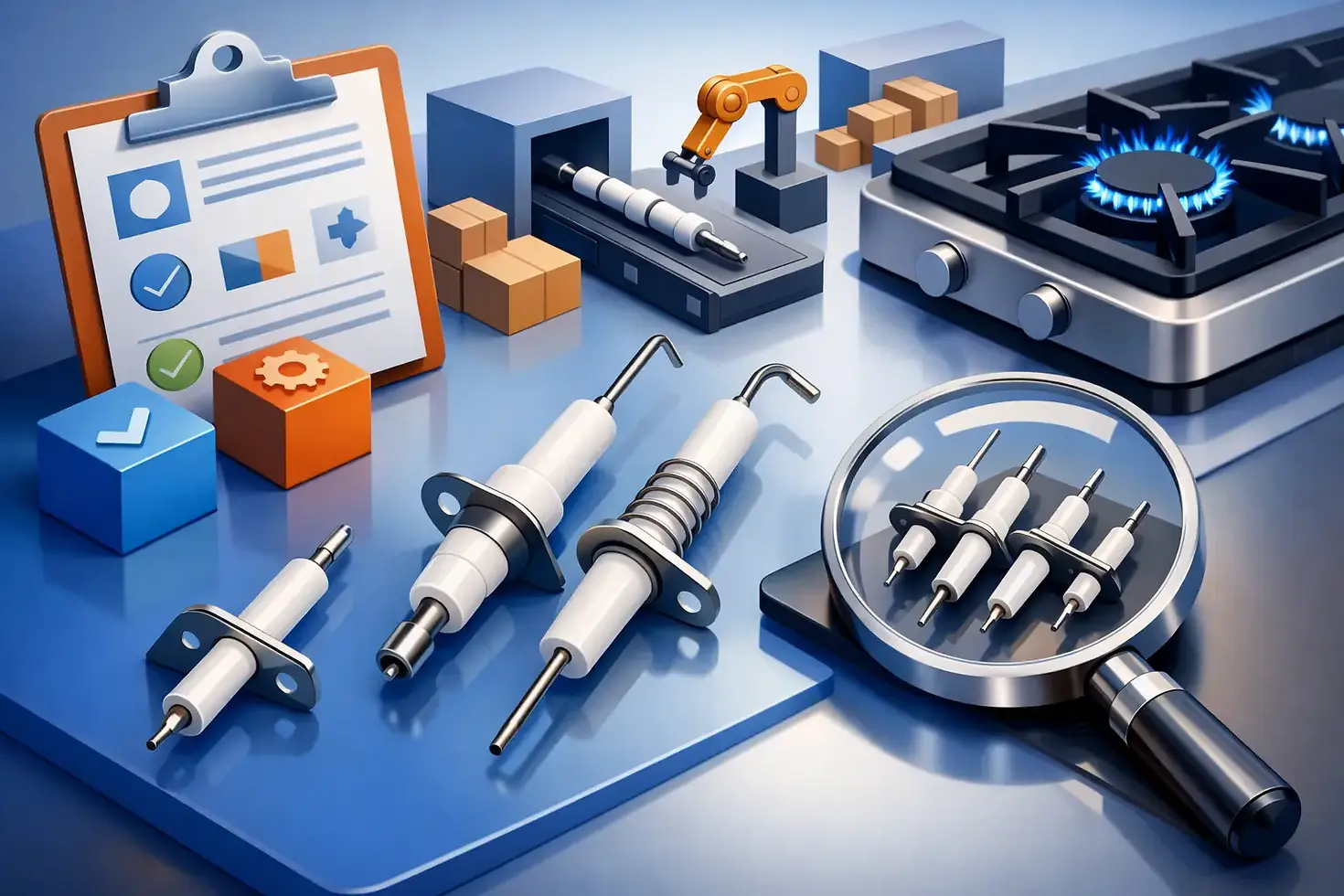
At a basic level, a stove ignition electrode supplier provides the electrode assemblies used to generate ignition sparks in gas stoves, cooktops, ovens, and related equipment. For industrial buyers, the real requirement is broader. The supplier should be able to support application fit, repeatable manufacturing, and long-term supply stability.
An electrode is not just a consumable component. It is part of a functional ignition system. The ceramic body, conductive rod, terminal design, insulation properties, mounting method, and dimensional consistency all influence whether ignition is fast, stable, and repeatable. A mismatch in any one of those variables can create field issues that are expensive to diagnose after launch.
For that reason, the strongest suppliers work upstream as well as downstream. They help define the component correctly during development, then manufacture it with process control that holds up at production volumes.
Why OEMs outgrow catalog-only sourcing
Catalog parts can work when the appliance architecture is standard and the performance window is forgiving. But many OEM applications are not that simple. Burner layouts vary. Temperature exposure varies. Mounting space is often constrained. Electrical requirements may differ across product lines or export markets.
This is where a stove ignition electrode supplier with engineering capability becomes more valuable than a distributor of off-the-shelf parts. Customization may involve adjusting rod length, ceramic profile, connector type, lead configuration, mounting features, or insulation characteristics. Small design changes can improve ignition reliability, simplify assembly, or reduce failures caused by thermal stress and handling.
There is a trade-off, of course. Custom components require tighter coordination and a more deliberate validation process. But for manufacturers building branded equipment at scale, that effort often pays for itself through better performance consistency and fewer production compromises.
How to evaluate technical capability
The first question is not whether a supplier can quote the part. It is whether they understand the application.
A capable supplier should be able to discuss operating conditions in practical terms. That includes thermal cycling, dielectric performance, spark behavior, dimensional tolerances, ceramic integrity, and compatibility with the rest of the ignition system. If the conversation stays limited to pricing and lead times, that is usually a warning sign.
Technical capability also shows up in the way the supplier approaches design review. Do they ask about burner position, ignition distance, mounting constraints, and service environment? Can they identify risks before tooling or production begins? Can they recommend changes that improve manufacturability without compromising function?
For OEMs, this matters because ignition issues are rarely isolated. A component that is technically acceptable on paper may still create assembly inefficiencies, inconsistent field performance, or preventable quality escapes.
Design support reduces downstream cost
Engineering support early in the process often prevents larger costs later. When a supplier can participate in design refinement, manufacturers are less likely to face repeated prototype changes, production line adjustments, or warranty claims tied to ignition instability.
This is especially relevant for companies managing multiple appliance platforms. Standardizing where possible, while still tailoring electrodes to each application, can simplify sourcing and improve quality control across product families.
Manufacturing discipline matters as much as design
Even a well-designed electrode can become a weak point if manufacturing control is inconsistent. For buyers evaluating a stove ignition electrode supplier, production capability should be reviewed with the same scrutiny as engineering support.
Consistency in ceramic processing, metal insertion, assembly, inspection, and packaging all affect final performance. Electrodes are exposed to heat, vibration, handling, and repeated use. If process variation is not controlled, the result may be intermittent ignition failure rather than immediate total failure, which is often harder to catch before products reach the field.
Manufacturing discipline should include traceability, inspection criteria, process validation, and clear change management. If materials or process parameters change, the OEM should know. Silent changes create avoidable risk, especially in regulated or safety-sensitive applications.
Quality systems should be practical, not just present
Many suppliers claim to have quality systems. The better question is how those systems show up in daily production. Buyers should look for measurable controls, documented inspection routines, and a clear response process when nonconformities appear.
A dependable supplier can explain how they manage lot consistency, incoming materials, dimensional verification, electrical testing, and corrective action. That level of transparency is not administrative overhead. It is part of protecting product reliability and keeping production schedules intact.
Supply continuity is a strategic factor
For procurement teams, supply continuity often becomes the deciding factor after technical approval. A component that passes validation but arrives inconsistently is still a production problem.
That is why supplier evaluation should include capacity planning, lead time realism, inventory strategy, and responsiveness under demand changes. Can the supplier scale with a new product launch? Can they support forecast swings without sacrificing quality? Do they have enough vertical control to reduce dependency on fragmented third parties?
This is where an engineering and manufacturing partner has a structural advantage. When design knowledge and production capability sit closer together, issue resolution is usually faster. Communication is shorter. Accountability is clearer.
For OEMs serving competitive markets, that operating model can reduce friction across development, sourcing, and after-sales support.
Customization without creating complexity
Customization is valuable, but only when it is controlled. Some manufacturers hesitate to customize ignition components because they do not want to increase part count complexity or make procurement harder. That concern is valid.
The answer is not to avoid customization altogether. It is to work with a supplier that can tailor the component while keeping manufacturability, repeatability, and lifecycle support in view. Good customization solves a defined problem. It does not create a new one.
For example, a revised mounting geometry may improve assembly alignment. A modified ceramic body may increase durability in a hotter zone. A connector adjustment may streamline integration with the ignition module. These are practical improvements when managed within a disciplined engineering process.
What long-term partnership looks like
The best supplier relationships do not start and end with a purchase order. They develop around continuity, technical communication, and a shared understanding of product requirements.
A strong stove ignition electrode supplier should be able to support prototype development, pre-production refinement, ramp-up, and ongoing supply. They should also be prepared to respond when field feedback reveals an improvement opportunity. That does not mean every issue disappears. It means the supplier has the technical depth and operational structure to address it responsibly.
For industrial customers, this partner model reduces the burden of managing separate design advisors, component vendors, and manufacturing contacts. It creates a more direct path from requirement definition to repeatable output. That is particularly useful when timelines are tight or product roadmaps require ongoing adaptation.
Companies such as Electronica Eltec operate in that space by combining engineering, application-specific electronics development, and manufacturing support under one structure. For OEMs, that kind of alignment can be more valuable than chasing the lowest nominal component cost.
The right choice depends on your product strategy
Not every buyer needs the same supplier profile. If the application is simple and volumes are modest, a standard source may be enough. If the product line is performance-sensitive, highly branded, or operationally complex, the supplier needs to do more than fulfill a part number.
The right evaluation framework should balance technical fit, quality control, customization capability, production readiness, and long-term support. Price still matters, but low cost without stability usually moves the expense somewhere else - scrap, delays, service issues, or field failures.
A reliable ignition component tends to go unnoticed by end users. That is exactly the point. When the electrode performs consistently, the product feels dependable, the production line moves as planned, and service teams spend less time solving avoidable problems. A careful supplier decision at the component level can protect much larger outcomes across the business.
If you are assessing options, look for the supplier that understands both the spark and the system around it. That is usually where better products start.


Comments